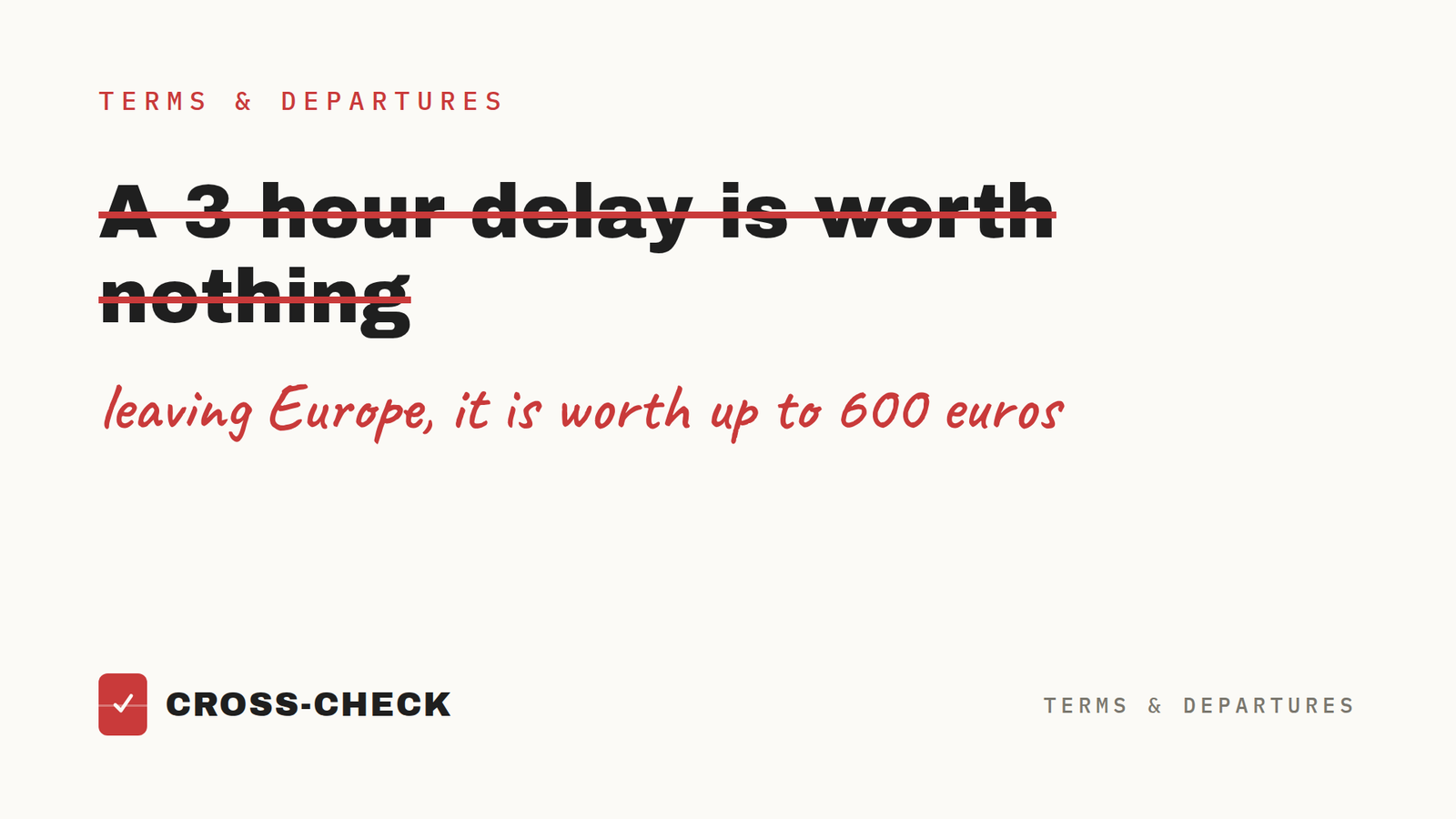
We covered the DOT refund rule a few weeks ago: cancel your flight and the airline owes you cash, automatically. That rule is genuinely good, and it has a hard edge. It refunds you. It does not compensate you. A five hour delay that eventually gets you there is worth nothing in the United States, and a Biden-era proposal to change that was scrapped.
Fly to or from Europe and a different law applies, one that pays actual money into your bank account.
The one rule that decides eligibility: direction
This is where most Americans get it wrong, so it goes first.
Departing the EU: always covered, on any airline. Your Delta flight home from Paris qualifies exactly as much as a Lufthansa flight does.
Arriving in the EU: covered only on an EU carrier. New York to Rome on Lufthansa is covered. The identical route on Delta or United is not.
So for a round trip from the US on a US airline, the outbound is unprotected and the return is protected. Same trip, same carrier, opposite answers. The regulation also covers Iceland, Norway and Switzerland, plus the French overseas departments, the Azores, Madeira and the Canaries. The UK runs a near-identical rule of its own post-Brexit.
What it pays
Compensation is 250, 400 or 600 euros depending on flight distance, currently around 290, 460 and 690 dollars. It triggers when your flight arrives more than three hours late at your final destination, or when the airline cancels fewer than 14 days out.
Two details that matter. It is per passenger, so a family of four on a long-haul delay is looking at 2,400 euros. And it is paid regardless of what you paid for the ticket. A 300 dollar fare can produce a 600 euro payment. You also keep the right to choose between a refund and rerouting on a cancellation. Compensation is on top of that, not instead of it.
The excuse to expect, and how to answer it
Airlines do not owe compensation for extraordinary circumstances, and they lean on the phrase hard.
Genuinely extraordinary: severe weather, air traffic control restrictions, political instability, strikes by airport staff. Not extraordinary, whatever they tell you: mechanical problems, crew shortages, IT failures, and strikes by the airline's own staff. If the plane broke or they could not find a pilot, that is the airline's problem and you are owed.
If you get the extraordinary-circumstances line for a maintenance delay, push back in writing or hand it to a claims service. Those services typically take 25 to 35 percent, which is worth it for many people because they will litigate.
The part worth checking tonight
You can usually claim retroactively, and the windows are long. Most EU countries allow claims going back three years. France allows five. The UK allows six. A delay from a trip you took in 2023 may still be worth money, and nobody is going to write and tell you.
That makes this one of the rare consumer-rights pieces with a task attached: go look at your old itineraries.
What changed in 2026
The regulation went through a reform fight this year and came out largely intact. The European Parliament approved the agreement by 646 votes to 12. The three compensation tiers of 250, 400 and 600 euros survive, as does the three hour threshold and the right to choose reimbursement or rerouting. New procedural rules that took effect in February 2026 make claims easier to file and process, and a new protection stops airlines denying you the return leg because you skipped the outbound.
How to claim
Email the airline directly first. Cite the regulation by name, state the flight, the date, the arrival delay and the amount, and give them a deadline. Something like: claiming under EU Regulation 261/2004 for flight X on date Y, which arrived Z hours late, entitling me to a specified amount, payment requested within 14 days, failing which you escalate to the national enforcement body.
That last clause matters. Every EU country has an enforcement body, and airlines know which ones bite.
Bottom line: if you have flown home from Europe in the last three years and landed more than three hours late, check the date and file. It is a short email against a few hundred euros.
How we checked this
Verified September 2026 against: Thrifty Traveler's EU261 guide for the US context and the scrapped DOT delay-compensation proposal; The Points Guy for the geographic scope including non-EU territories and codeshare treatment; Autopilot's 2026 flight delay guide for the three hour threshold and the extraordinary-circumstances breakdown including the February 2026 procedural rules; MissedTransit for the directional coverage rule, claim letter structure and per-country claim windows (three years most EU, five France, six UK); Touring Tony on the 2026 reform fight; and Aran Grant for the reform outcome, the 646 to 12 vote, the retained compensation tiers and the new return-ticket protection. Reform implementation dates vary; the current regulation text governs your claim.
No affiliate relationships. When that changes, you'll read it here first.