The internet's advice on rental car insurance is close to unanimous: your credit card already covers it, decline everything at the counter, stop handing over 150 dollars a week for something you own.
Mostly correct. But it collapses two different products into one word, and there is a specific situation where following it leaves you driving off the lot functionally uninsured.
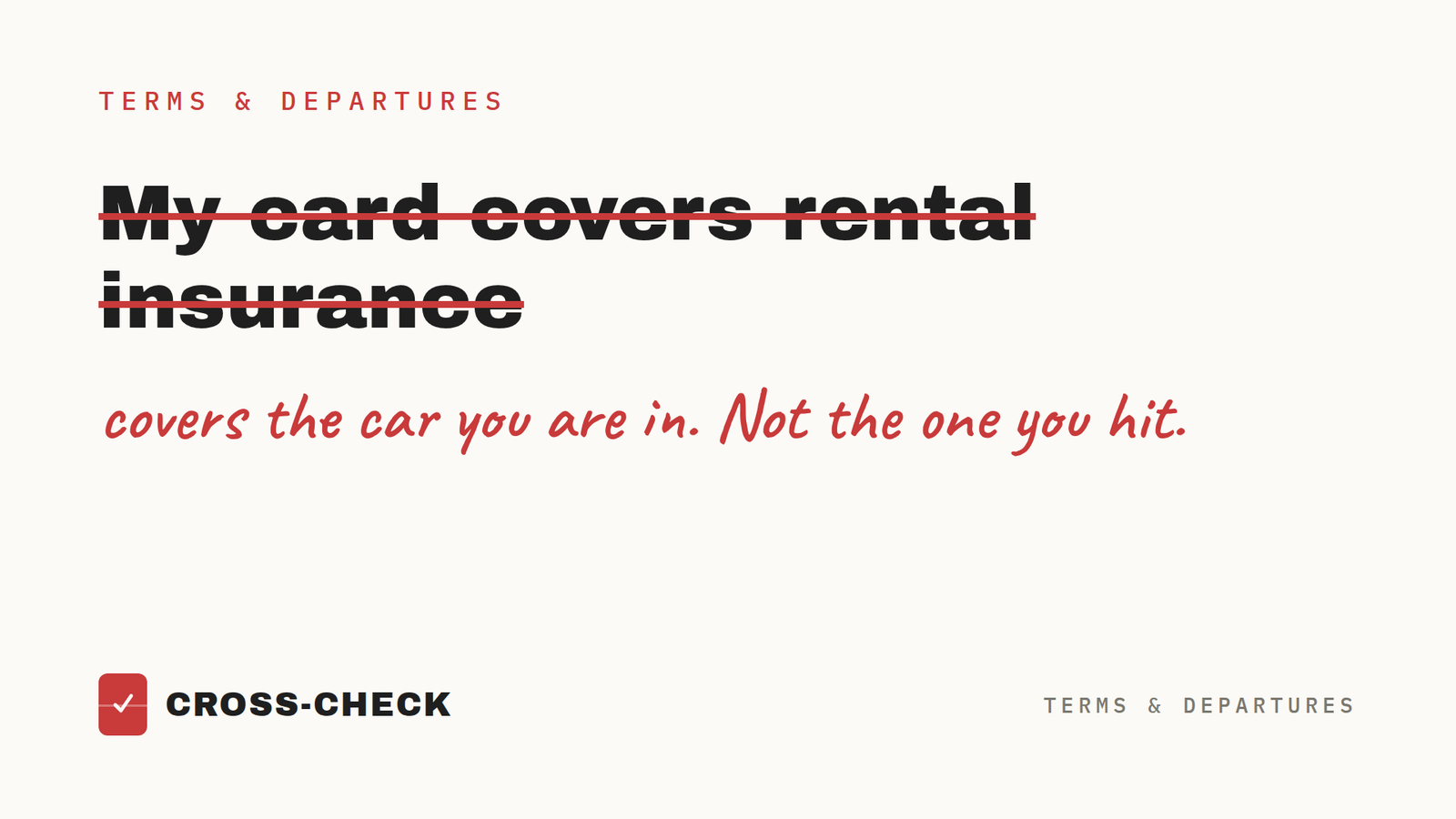
My credit card covers rental car insurance covers damage to the rental car. Not what you do to anyone else.
The two things the counter is selling
CDW or LDW is the damage waiver, and it is not insurance. It is a contract in which the rental company gives up its right to charge you for damage to their vehicle. CDW covers collision; LDW usually adds theft and vandalism. Most companies use the terms interchangeably, so read the document rather than the label. It runs roughly 15 to 45 dollars a day in 2026.
SLI, supplemental liability, is different in kind. It covers what you do to other people and their property. Your credit card does not provide this. No card does.
That distinction is the whole post.
Where the credit card advice is correct
Charge the full rental to an eligible card, decline the CDW or LDW, and the card's auto rental collision damage waiver covers physical damage to the vehicle, theft, reasonable towing, and loss-of-use fees the rental company charges while the car is in the shop.
Know which kind you have. Primary coverage pays first and you never involve your own auto policy. Secondary only pays after your personal insurance does, which means a claim on your record and possibly a higher premium. Amex sells a Premium Car Rental Protection upgrade that converts secondary to primary for about 19.95 to 24.95 per rental, which is per rental and not per day, with coverage up to 100,000 dollars. On a week-long rental that is dramatically cheaper than the counter's daily waiver.
Cards also carry exclusions worth checking before you decline anything: luxury and exotic vehicles, large trucks, long rental periods, and specific countries. Italy, Israel and Ireland are the usual named exclusions.
The five-state gap
Here is the part the standard advice misses.
Rental companies must carry state-minimum liability coverage almost everywhere in the US. The exceptions are California, Missouri, New York, Texas and Utah, where state law does not require the rental company to provide that contingent liability coverage.
In those five states, if you do not own a car, and therefore have no personal auto policy extending to the rental, and you decline the counter's liability product because a credit card article told you to decline everything, you are driving without liability coverage. The card covers the car you are in. Nothing covers the car you hit.
If you own a car and carry your own policy, this generally does not apply to you; personal auto usually extends to rentals for personal use at your own coverage levels and deductibles. The exposure is specific to people without a personal policy, which increasingly includes urban renters who gave up car ownership.
The counter script
Decline the CDW or LDW and initial the decline line. Pay the entire rental on the card that carries the benefit, because partial payment can void it. Do not decline liability unless you have confirmed your own policy covers you.
If damage happens, photograph everything before you leave the lot and again at return, and file with your card's benefit administrator within 30 days. You will need the rental agreement, damage photos, the repair estimate and the charge receipt.
Two more counter behaviours worth naming, because they are common: staff describing the waiver as mandatory, and staff pushing a higher waiver tier than the vehicle needs. You are entitled to see the waiver terms in writing before agreeing to any charge.
Bottom line: decline the damage waiver with confidence. Treat liability as a separate question with a different answer, and if you do not own a car and you are renting in one of those five states, buy it.
How we checked this
Verified September 2026 against: Coverage Criteria's rental insurance requirements guide for the five-state contingent liability exception and personal auto extension rules; travel-code.com's 2026 CDW guide for waiver mechanics, pricing, primary versus secondary distinctions and the Amex Premium Car Rental Protection per-rental pricing; 24/7 Wall St and AOL for the credit card coverage scope and the liability caveat; finalrentals for 2026 CDW and LDW price ranges and counter pressure tactics; RoadSUV for commonly excluded countries; and Wealthvieu for the claims process and 30-day filing window. Coverage varies by card, insurer and state, and card benefit guides are revised regularly; your card's current guide to benefits and your own auto policy are the documents that govern.
No affiliate relationships. When that changes, you'll read it here first.