Welcome to Off Peak, the franchise about when rather than where. The Overrated Index tells you whether a place is worth it. This one tells you which weeks are worth it, because for most destinations the answer varies by more than the destination choice does.
We are starting with the clearest example on the calendar, and one you can act on today.
November in the Caribbean: still hurricane season, too risky technically yes, statistically over by mid-month
The arbitrage
Atlantic hurricane season is defined as June 1 through November 30. Pricing follows that definition. Storms do not.
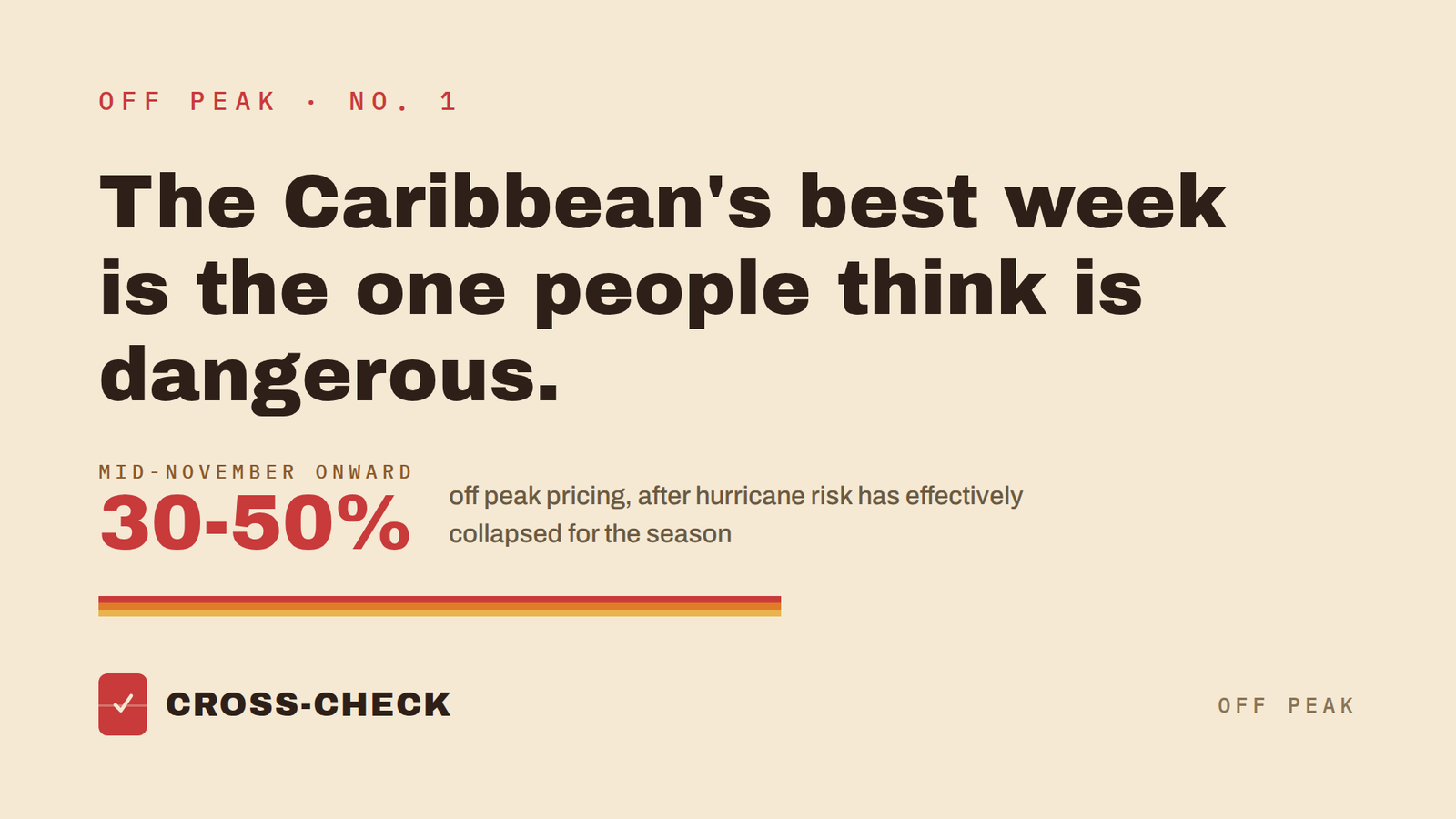
Activity drops fast in early November, and by mid-month the season is effectively finished. Meanwhile airlines and resorts hold off-peak pricing through Thanksgiving, because the calendar says hurricane season and the calendar does not care about the statistics. Flight and resort rates during the September-through-early-November window run 30 to 50 percent below peak, and late November specifically has been characterized as hurricane-season pricing with negligible risk and weather already cooling toward ideal.
That gap between when the pricing ends and when the risk ends is the entire trade.
Where the risk actually concentrates
Not evenly, which is the part most coverage flattens.
By month: September is the statistical peak, with the climatological high point around September 10, and the second and third weeks of the month the most active stretch of the year. October remains genuinely risky, particularly for the eastern Caribbean and the Lesser Antilles early in the month. Risk drops sharply in early November and is negligible after mid-month.
By geography: the northern Caribbean carries the most exposure: the Bahamas, Turks and Caicos, the Virgin Islands, and the leeward chain. The southern islands are a different proposition. Aruba, Bonaire, and Curacao sit 15 to 70 miles off Venezuela, largely outside the storm track, and Aruba has taken only a handful of direct hurricane hits in recorded history. Trinidad, Barbados, and the southernmost Grenadines also run materially lower risk.
Combine those two facts and the November-in-the-ABCs version of this trip carries about as little weather risk as a Caribbean trip can carry while still being priced as though it were September.
The honest counterweight
We are not going to pretend this is free money.
Last October, Hurricane Melissa hit Jamaica as a Category 5. That was inside the window this post is telling you is cheaper, and it is the reason "statistically low risk" is a probability statement rather than a promise. NOAA's database records 90 Caribbean hurricanes between 1966 and 2025. The season is real; it just is not uniformly distributed, and pricing behaves as though it is.
Two more caveats worth stating plainly. First, November is the tail of the wet season in much of the region, so some islands still see more rain than the December-through-April dry season. Second, this year's forecast calls for fewer storms than usual, and forecasts are not outcomes. Travel demand is already responding: Squaremouth data reported this month shows Caribbean travel during this hurricane season running 21 percent above the same period last year, which suggests the arbitrage is being noticed.
How to take the trade
Aim mid-November or later if you want the risk near zero rather than merely low. Late November is the sweet spot: still off-peak priced, effectively post-season.
Or go south instead of late. The ABC islands, Barbados, or Trinidad let you take the discount earlier in the fall with structurally lower exposure.
Book 1 to 3 months out for the best fares in this window, which as of today means it is the right time to be booking.
Buy the coverage that matches the risk. For any Caribbean trip booked June through November, a policy with weather cancellation coverage is worth pricing, and cancel-for-any-reason is the version that covers a decision to bail when a forecast turns. Read our audit of what CFAR actually pays before you buy it: it reimburses 50 to 75 percent, never 100, and it has to be purchased within roughly two to three weeks of your first deposit.
Prefer resorts with flexible cancellation and, if you are cruising, know that ships reroute around storms rather than sail into them, so the risk on a cruise is a changed itinerary far more often than a dangerous one.
Bottom line: the last two weeks of November are the best price-to-risk window on the Caribbean calendar, and they are underpriced for the boring reason that a date on a NOAA definition has not caught up to the weather it describes.
How we checked this
Verified August 2026 against: NOAA season definition and peak timing as reported across current guides; month-by-month risk breakdowns from vacationpro.co and adventuresbymj.travel (early November drop-off, late November negligible risk, September 10 climatological peak, second and third weeks of September as most active); geographic risk distribution and ABC island exposure from Going.com's hurricane season guide and adventuresbymj.travel; 30 to 50 percent off-peak pricing from Yahoo Travel's Caribbean price drop analysis and Going.com; the 21 percent year-over-year increase in hurricane-season Caribbean travel from Squaremouth via Caribbean Journal, August 2026; Hurricane Melissa and the 90-hurricane NOAA figure via Weather.com; and booking-window guidance from Expedia data cited in the Yahoo Travel piece. Forecasts change and storms do not read statistics. Check the National Hurricane Center before and during any trip in this window.
No affiliate relationships. When that changes, you'll read it here first.