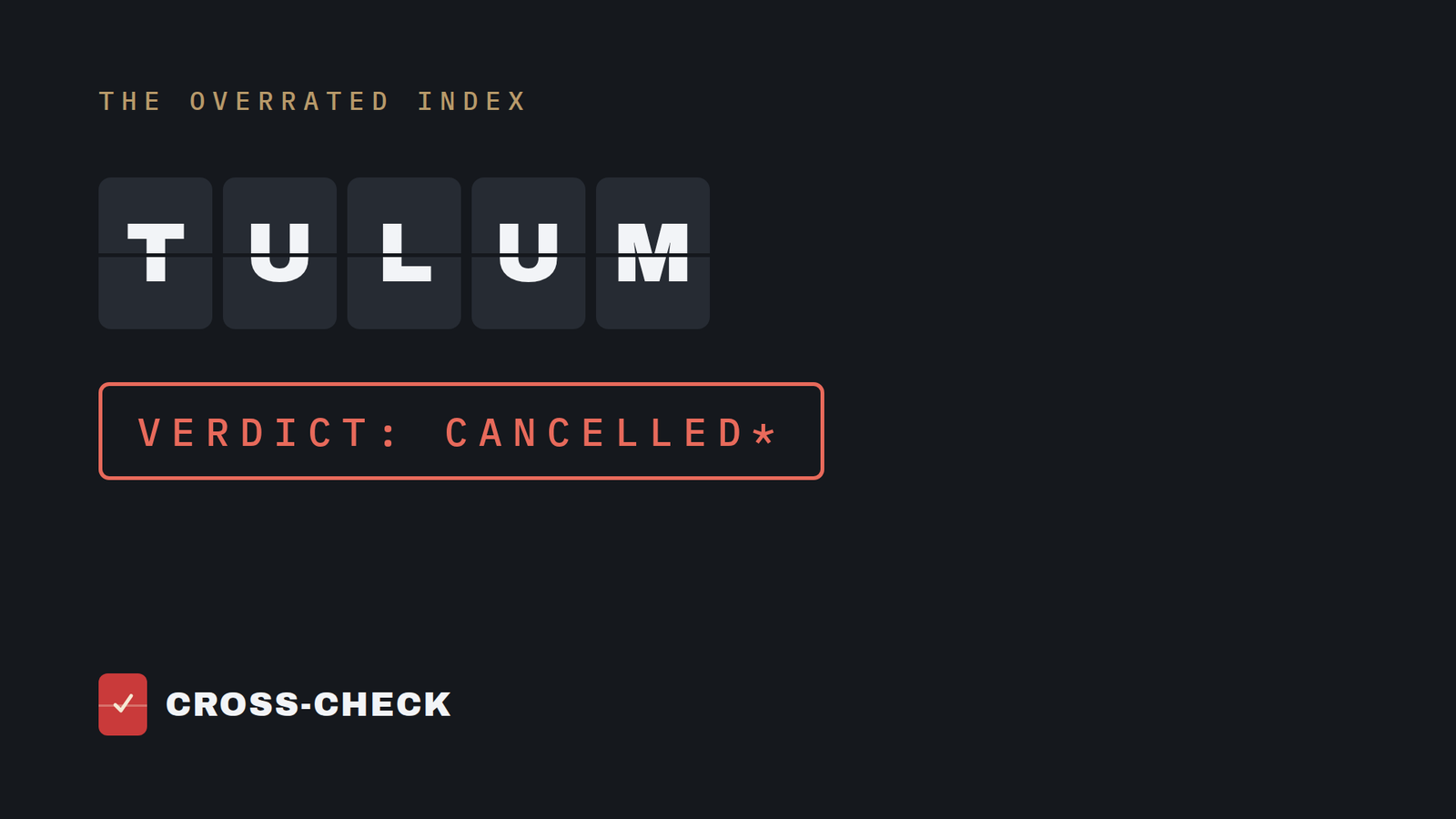
Last week this board cleared Santorini, and the logic was simple: a demand slump plus a cruise cap fixed the exact thing that made Santorini miserable, so the discounts pay you to show up while the window lasts. Tulum is also in a slump. Tulum also has discounts. You might expect the same verdict.
It gets the opposite one. The difference between those two calls is the entire point of this franchise.
Tulum right now: a luxury beach escape at 35% off a 35% discount on beaches behind record seaweed and an entry fee
What the numbers say
Tulum is in what local officials themselves have called its worst tourism crisis in over a decade. Reporting through late 2025 put coastal hotel occupancy around 30%, with the town center as low as 15%; state tourism data showed occupancy near 49% against 66.7% the year before. Luxury properties cut rates by as much as 35%.
Cheap and empty can be a buying signal. Santorini proved that a week ago. The question that decides the verdict is why it emptied, and whether those reasons are gone. Here's the audit.
The sargassum is at record levels and got worse this year. The 2025 seaweed bloom was the largest on record, and 2026 has been heavier still: authorities collected roughly 2,500 tons in Tulum by mid-year versus 1,300 tons over the same period in 2025, with Mexican Navy data showing arrivals at more than double last year's volume. This is the beach the trip is for, and peak bloom season runs through summer.
The free beach went behind a gate. The Parque Nacional del Jaguar reserve put much of the coastline behind entry fees: about $22 for foreign visitors to beaches that used to cost nothing. It sparked protests, which won residents free access. A visiting family of four still pays roughly $88 to reach the sand, before a chair, before a drink.
The pricing reputation is earned. This is the town of the $10.50 coconut, where business owners have publicly apologized to domestic tourists and former hotel association leadership describes years of plain rate abuse. The 35% discount is measured against those prices.
Security data tells two stories. As of October 2025, Mexico's National Citizen Observatory ranked Tulum the most violent municipality in Quintana Roo, at 529 crimes per 100,000 residents. Federal figures presented in July 2026 claim sharp improvement statewide: an 85% drop in the daily homicide average since September 2024 and a 15% decline in high-impact crime. Both come from parties with a stake in the story. We report the conflict rather than resolve it.
The plot twist, three days old
On July 17, 2026, Mexico's president announced Plan Tulum Renace, a federal rescue strategy aimed at exactly the grievances above: free Jaguar Park entry for Mexican nationals, archaeological zone fees cut to 80 pesos for nationals (free Sundays) and 265 pesos for foreign visitors, ten public beach access points including two fully free entrances in the hotel zone (Playa Conchitas at km 4.5 and Playa del Pueblo at km 5.5, open to everyone), a 20-peso electric shuttle, a National Guard tourist-assistance model, and a price-monitoring program aimed at the gouging problem by name.
That is a government conceding, in an official plan, nearly every complaint in this post. It is also three days old.
The Santorini test, applied
Our rule from last week: a slump clears a destination only when the slump fixes the problem. Santorini's problem was crowds; the cap and the dip solved it. Tulum's problems are seaweed, fees, pricing culture, and trust. The dip solved none of them, and the rescue plan is too new to have proven anything. Announced reforms are press conferences until the receipts arrive.
So: CANCELLED today, with the most interesting re-check on the board. If the beach access holds, the price monitoring bites, and the sargassum recedes, Tulum could become the rare destination that earns its way back to CLEARED at a discount. We would genuinely rather write that post than this one.
If you're going anyway
Winter months (roughly November through March) historically bring far less sargassum, the cenotes and ruins are unaffected by any of the beach math, and the new free access points are real as of this writing. Price the fees into every beach day and agree on taxi fares before getting in.
How we checked this
Verified July 2026 against: occupancy and rate figures from travel trade and regional press (Travel Weekly, Yucatan Magazine, La Revista Binacional citing the Quintana Roo Tourist Information System); sargassum tonnage from Mexican Navy data via The Yucatan Times; beach fee history and protest reporting via Yucatan Magazine and CNN; the October 2025 crime ranking from the National Citizen Observatory as cited in regional coverage; and the July 17, 2026 Tulum Renace announcement from the presidential press conference as reported by The Rio Times, Tribuna, and CC News, including the federal security claims. We have not walked these beaches this season; every claim is sourced from reporting and official data, flagged per our methodology.
No affiliate relationships. When that changes, you'll read it here first.