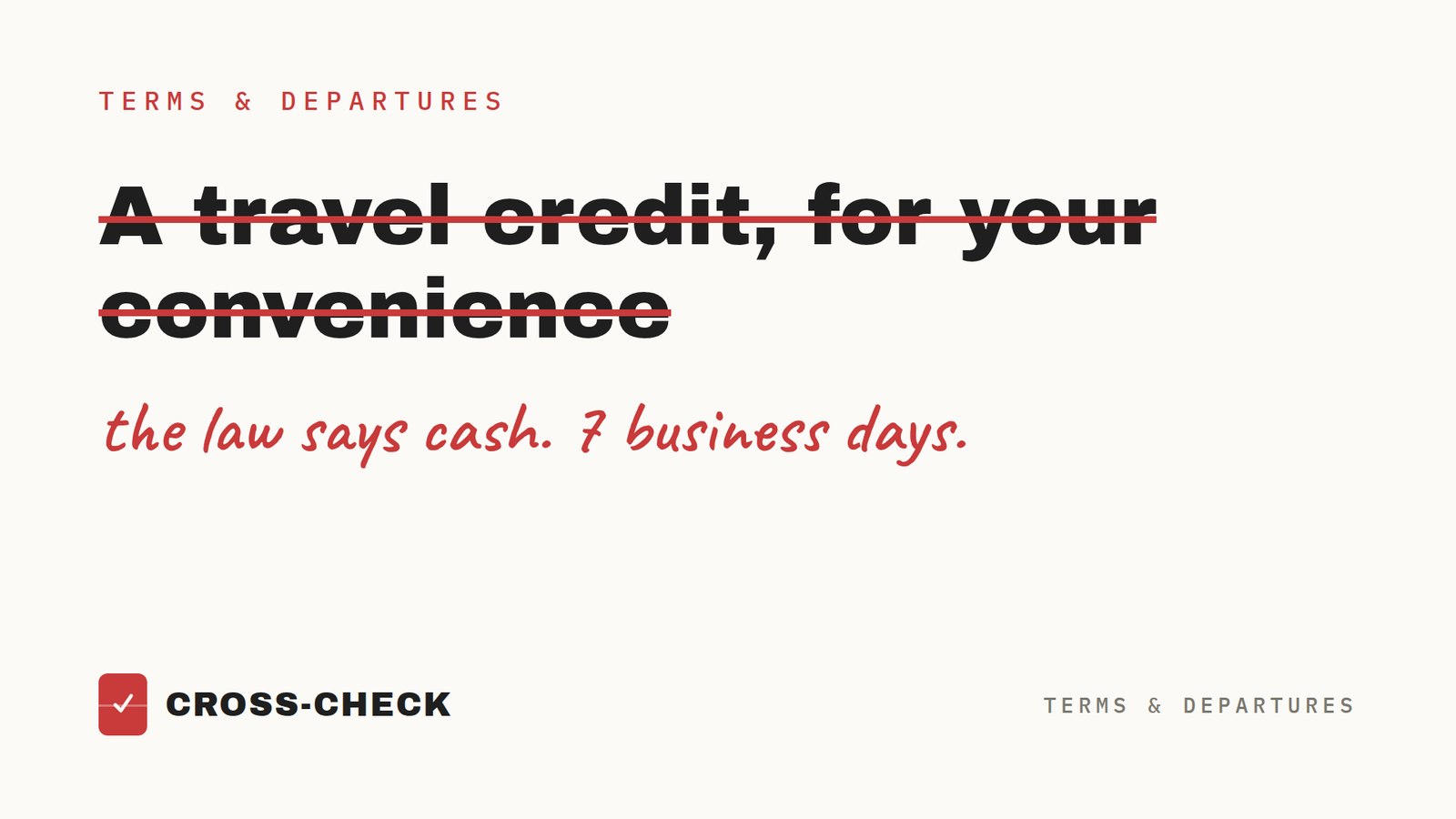
Your flight gets cancelled. The airline's app cheerfully offers a rebooking, and below it, a travel credit "for your convenience." Most people tap one of those buttons within minutes, which is exactly what the buttons are for — because since October 28, 2024, a federal rule has said the airline owes you an automatic cash refund, and tapping the wrong button is how you waive it.
The airline is offering you a generous travel credit for the inconvenience an opt-out from the cash refund federal rules already require
What the rule actually says
The Department of Transportation finalized it in April 2024; it took effect that October and lives at 14 CFR 259.5. It applies to U.S. and foreign airlines flying to, from, or within the United States — and yes, to nonrefundable tickets. Three situations trigger a refund:
1. Your flight is cancelled — for any reason. Weather, mechanical, staffing: the cause doesn't matter for the refund (it matters for rebooking niceties, not for your money). If you decline whatever alternative the airline offers, the cash refund is owed.
2. Your flight is "significantly changed." The rule finally put numbers on that phrase: a departure or arrival shift of 3+ hours domestic or 6+ hours international, a change of departure or arrival airport, added connections, or a downgrade in class of service. Any of those, declined by you, equals a refund.
3. You paid for something you didn't get. Wi-Fi that never worked, a seat assignment that evaporated — those fees come back. Checked-bag fees are refundable when your bag is significantly delayed: 12+ hours domestic, 30+ hours international, if you file a mishandled-bag report.
The deadlines have teeth: 7 business days for credit-card purchases, 20 calendar days for other payment methods, to your original payment method.
The one trap worth memorizing
"Automatic" has a boundary: accepting an alternative waives the refund. Take the rebooked flight, and that's your remedy. Accept the voucher, same. The rule requires airlines to make cash the default and get your affirmative opt-in for anything else — but an app flow that surfaces the voucher button first and the refund link somewhere below it is working that boundary as hard as compliance allows.
So the script is short. At the counter or in the app, the words are: "I decline the rebooking and any credit. I'm requesting a full refund to my original payment method under DOT's refund rule." You don't need to cite the CFR section out loud, though watching an agent's posture change when you do is one of air travel's few remaining pleasures.
When the voucher IS the right call
Honesty clause: if you still need to get where you were going, the rebooking is usually worth more than the refund — a same-day seat beats cash plus a walk-up fare on another carrier. And occasionally an airline sweetens a voucher well past the ticket's value. The rule's gift isn't that cash is always right; it's that the choice is now yours, on your timeline, with the default set in your favor. Take the refund when the trip is dead. Take the rebooking when it isn't. Never take the voucher just because the button was biggest.
If an airline stalls past the deadlines, file a complaint with DOT's Office of Aviation Consumer Protection — it takes minutes, and airlines answer those.
How we checked this
Verified July 2026 against the DOT final rule announcement and fact sheet (transportation.gov), the rule text at 14 CFR 259.5, and consumer-rights analyses of the trigger thresholds and waiver mechanics (LegalClarity, TravelStacks). Thresholds cited — 3/6-hour changes, 12/30-hour bag delays, 7/20-day deadlines — are from the rule itself. Enforcement climates change; the regulation's current text is the document that counts.
No affiliate relationships. When that changes, you'll read it here first.