
Ask most travellers which flight leaves their suitcase better protected, the one to Denver or the one to Dublin, and they will say Dublin. International feels more serious. There is a treaty involved.
The treaty is real. It is also the reason the international answer is worse.
International flights: better protected, there is a treaty the treaty is the cap, and it is roughly half the domestic one

The two numbers
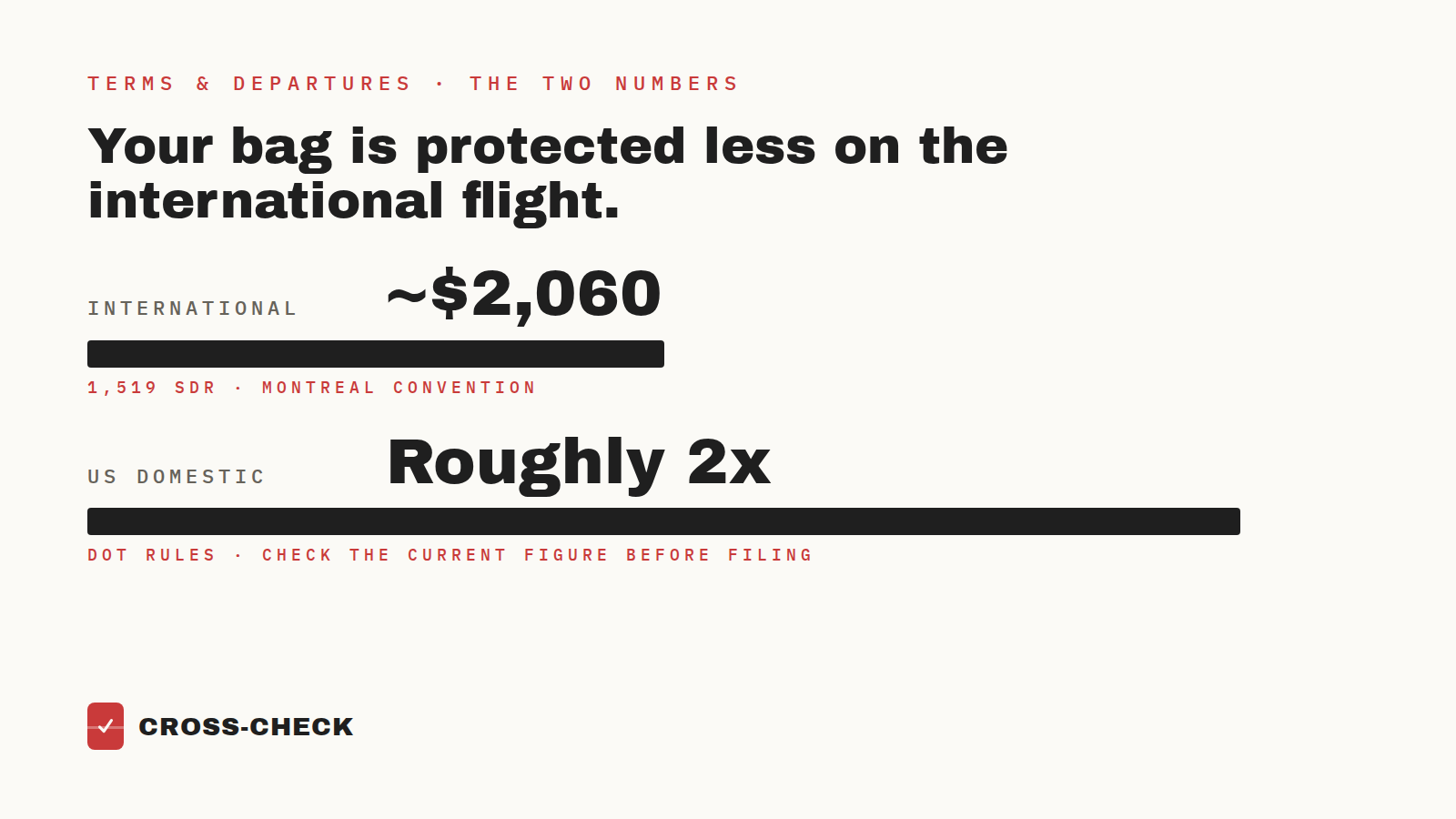
International: 1,519 SDR. The Montreal Convention governs international carriage and caps airline liability at 1,519 Special Drawing Rights per passenger. SDR is an IMF currency basket, so the dollar figure moves. It has run roughly $2,060 to $2,175 through 2026.
Note the date on any guide you read. That limit rose from 1,288 SDR on December 28, 2024, an increase of about 18 percent. Plenty of articles still quote the old number.
Domestic: higher. US DOT rules set the domestic cap well above the international one. Sources we checked cite figures from $3,800 to $4,700 per passenger, and we could not reconcile that gap, so treat the exact number as approximate and check DOT's current page before you file. Either figure is roughly double the international limit.
Both numbers are per passenger, not per suitcase. Two people sharing one bag do not get two caps for that bag.
The thing people get wrong about the cap

It is a ceiling on proven losses, not a payout.
If the airline loses a bag containing $600 of clothes, you get up to $600, not $2,060. You claim documented value. Conversely, if the bag held $4,000 of gear on an international flight, the cap is the cap and the remaining $2,000 is yours to absorb.
For delayed bags, you claim reasonable replacement essentials while you wait. Buy the clothes and the toiletries, keep every receipt. If the bag has not turned up after 21 days it is treated as lost and you can claim its value.
The deadlines, which are short
This is where most claims die.
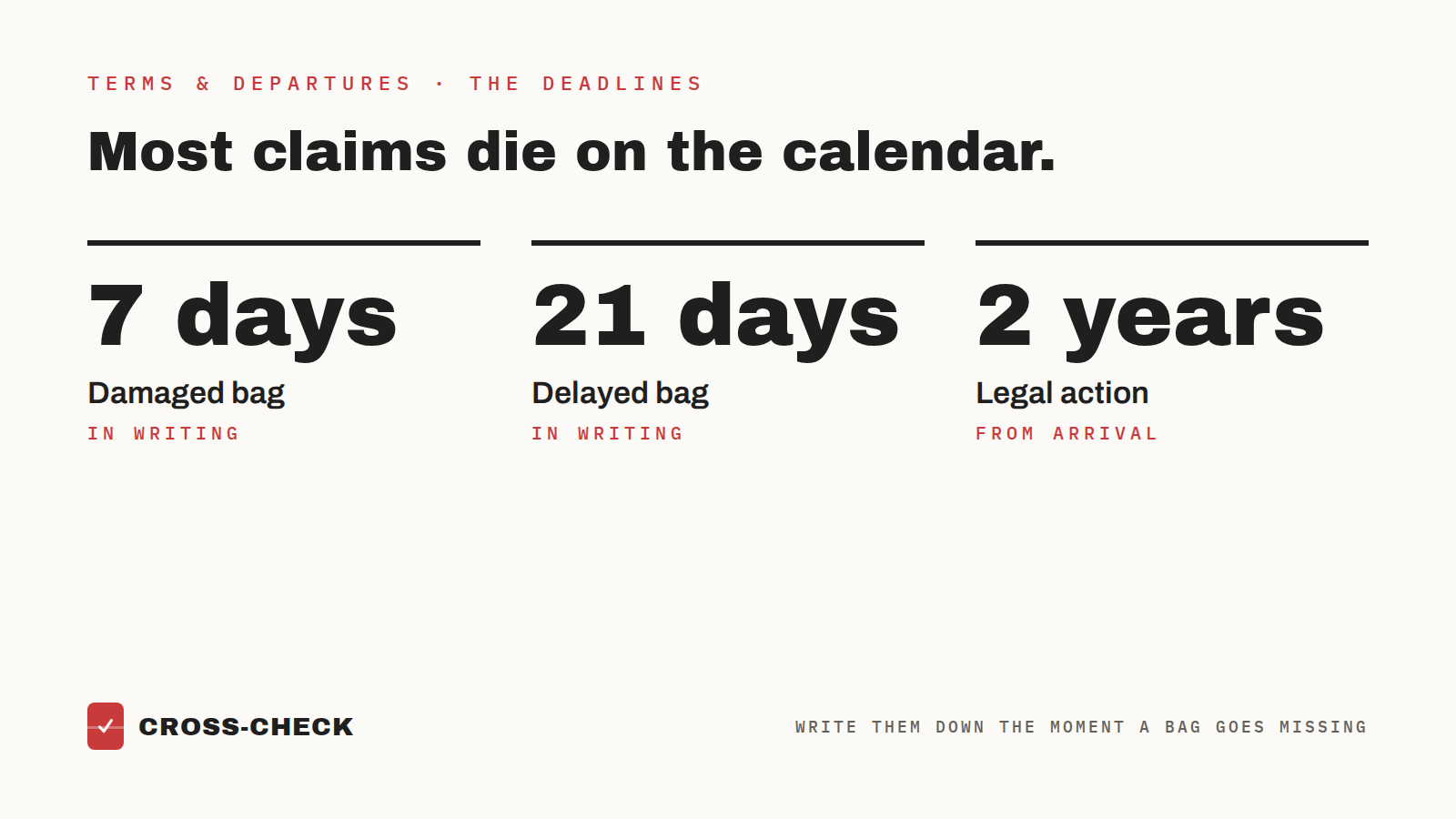
Damaged bag: 7 days, in writing. Photograph the damage before you leave the airport if you can, and keep the bag, because the airline may want to inspect or repair it.
Delayed bag: 21 days, in writing, from the date it is returned to you.
Legal action: two years. Much shorter than the three to six year windows for EU261 delay compensation, which we covered last week. Do not assume the same clock.
Normal wear and minor scuffs are excluded. So, generally, are cash, jewellery, electronics, documents and fragile items, which is the practical argument for keeping anything valuable in your hand luggage.
Hand luggage works differently
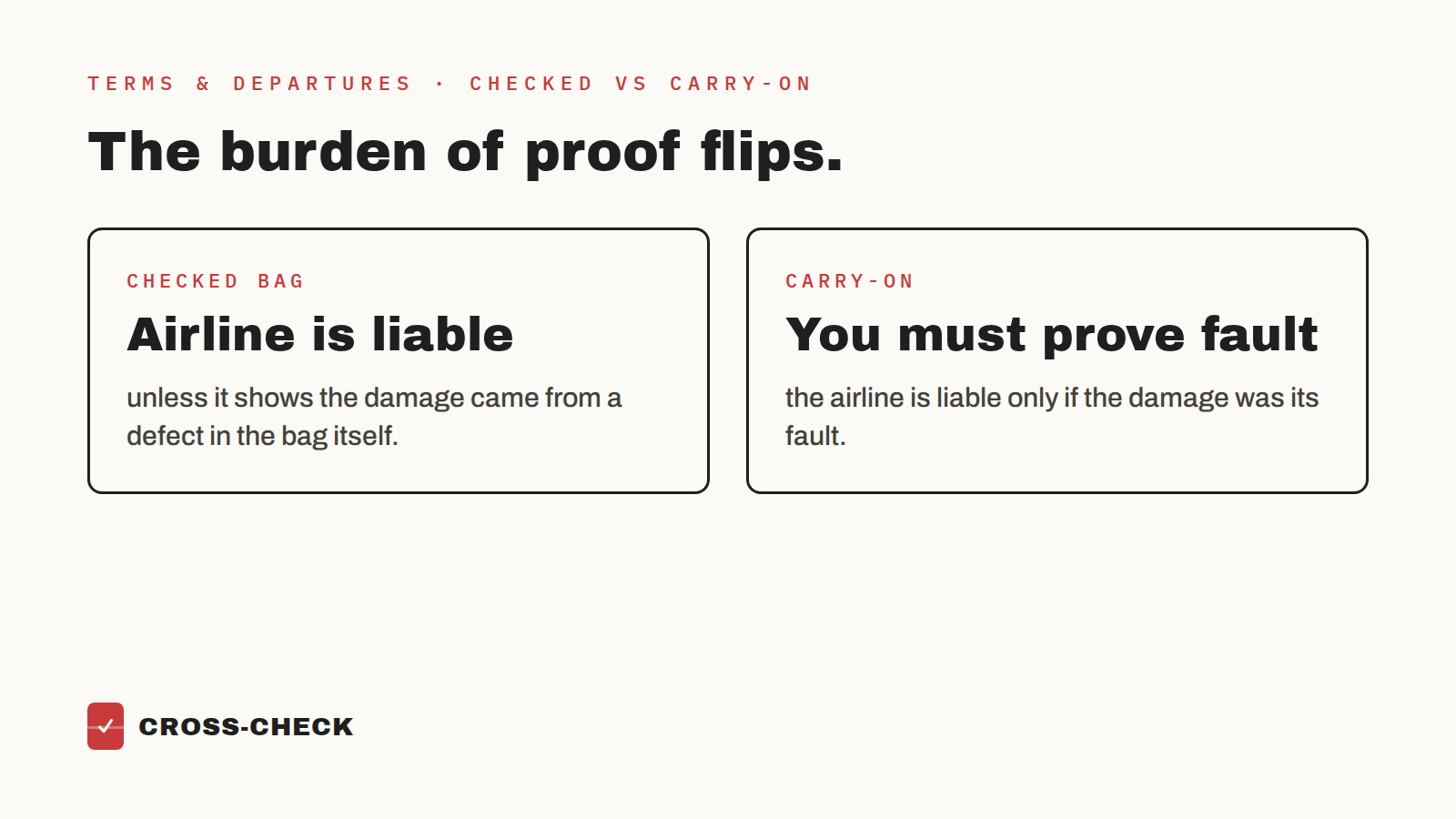
Checked baggage liability is close to automatic. The airline is liable for loss or damage that happened while the bag was in its charge, and it escapes only by showing the problem came from a defect in the bag or its contents.
For a carry-on you kept with you, the airline is liable only if the damage was its fault. The burden flips. Worth knowing before you argue at a service desk.
If your bag is worth more than the cap
Two options. Some airlines sell excess valuation at check-in; American charges about $5 per $100 of declared value up to $5,000. Or use travel insurance, which is often faster to pay and may cover categories the airline excludes.
For most people neither is necessary. For anyone flying with camera gear, instruments or professional equipment, the international cap is the number to plan around.
Bottom line: the treaty that sounds protective is the thing limiting you. Keep the valuable items on your body, keep receipts for everything you buy while a bag is missing, and put the 7 and 21 day deadlines in your calendar the moment a bag goes astray.
How we checked this
Verified September 2026 against: the US Department of Transportation's baggage page for the 1,519 SDR international limit and the approximately $2,175 conversion; Forbes Advisor for the March 2026 conversion of roughly $2,060 and American's excess valuation pricing; Clyde and Co's legal analysis of the December 28, 2024 ICAO revision raising the limit from 1,288 SDR (about 18 percent); Tripbuffer's 2026 guide for the deadline structure and exclusions; HeyGyro for the Article 17(2) and hand luggage distinction and the treatment of delayed baggage after 21 days; Flightright for the per-passenger rule and two year limitation; and Yahoo Travel and Tripbuffer for US domestic figures, which conflicted at $4,700 and $3,800 respectively and are flagged as unresolved in the text. Verify current figures with DOT before filing.
No affiliate relationships. When that changes, you'll read it here first.